Why Good Advertising Takes More Than Good Ads
By Jason Stanard | Forgelight Marketing Group

I’ve written on this topic several times and it’s still something I hear every day. Here’s how it goes:
Prospect: I want to talk to you guys about my advertising.
Jason: Sure thing, let’s start with what are your goals for your advertising?
Prospect: I WANT LEADS OR SALES AND My ads suck.
Jason [after research]: Well, after reviewing your current ads, your campaigns, and your website/landing page(s) it seems to me the ADS ARE NOT THE PROBLEM.
A strong ad can get someone to click. What happens next determines whether that click becomes a lead or a sale. If the campaign reaches the wrong target audiences [Campaigns], the creative [Ads] don’t drive the prospect to click or call, or the [Website] leaves visitors confused, better-looking ads won’t fix the whole situation.
For advertising designed to generate action on your website, I think about it this way:
Conversions = Campaigns + Ads + Website
It’s a planning framework, not a literal mathematical equation. I tell every prospect; Advertising is part Art and part Science. Campaigns determine who you reach and when. Creative communicates to the intended audience and gives those people a reason to respond. Your website or landing page helps them take the next step. Each part needs to support the others.
[Campaigns] need different jobs and measurable goals
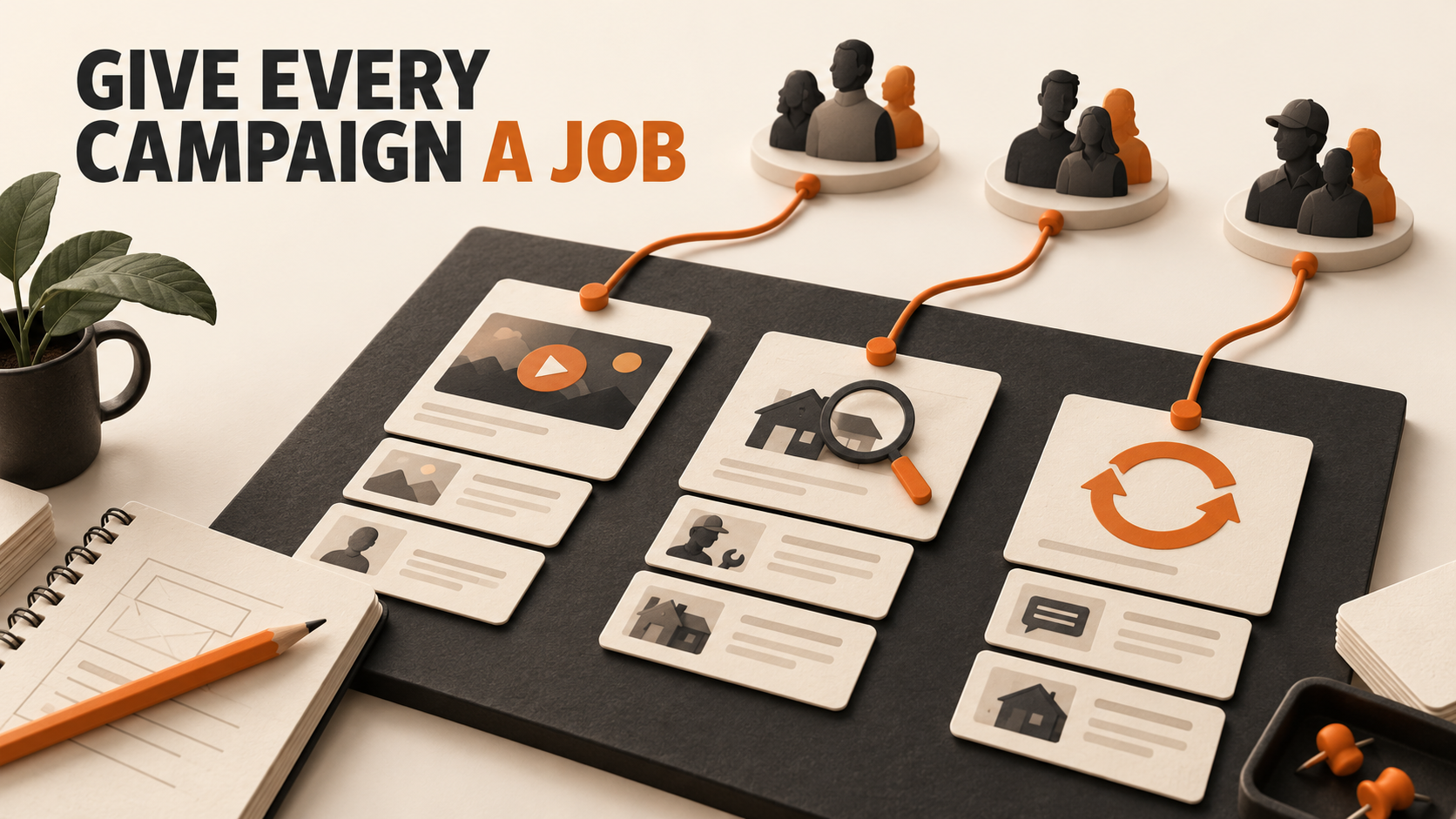
First and foremost; clearly defining your correct target audiences drive how campaigns are established. It also determines which advertising platform(s) you’ll develop your campaigns in. Someone encountering your company for the first time needs different information from someone comparing providers or preparing to buy. A useful campaign plan accounts for those differences.
For a home-services business, that might mean video introducing the company, ads showing completed projects, search campaigns reaching people looking for that service, and retargeting that addresses questions previous visitors may still have. Each campaign has a job, with messaging and a destination that fit it.
Ipsos’s 2025 analysis of 50 cross-media campaigns supports a coordinated approach. Its recommendations emphasize choosing media around audience preferences and budget constraints, with investment focused enough to have an impact. [1]
Multiple campaigns can address different services, audiences, buying stages, or offers. Splitting a small budget across too many campaigns can leave each with too little activity to evaluate. Define success before spending. A lead-generation campaign needs scrutiny of qualified inquiries and acquisition cost. Measure each against its role, then review how the plan contributes to the business overall.
[Ads] need to communicate to the intended audience

An attractive ad still has to answer: why should I click on you?
“Quality service you can trust” could describe thousands of companies. An ad addressing a specific problem, showing relevant work, or explaining a useful offer gives the intended audience more to recognize. A homeowner planning a kitchen renovation and a property manager maintaining rental units may buy similar services for very different reasons.
Test meaningful differences in the message, visual, format, and call to action. A new background color is a variation. Addressing a different customer concern is a new reason to respond.
Google’s Search Quality Score framework reflects this connection: it considers expected click-through rate, ad relevance, and landing page experience. Google describes Quality Score as a diagnostic tool, rather than a business performance metric. [2]
Click-through rate helps show whether an ad earns a response from the audience seeing it. Judge it in context: platform, placement, audience, and campaign purpose all matter. Then look at what those clicks produce. A compelling headline that attracts people you can’t serve can improve CTR while making lead quality worse.
The [Website] needs to deliver on the ad

If an ad promotes a kitchen-remodeling consultation, the visitor should arrive on a page about that consultation. Sending them to a general homepage and asking them to find the offer adds work at the moment you want them to act.
NOTE: More often than not people overload the site visitor with options, choices, offers, etc. Too many mind. No mind [The Last Samurai]. You’re giving site visitors too many choices and not a clear path on where YOU want them to go and what YOU want them to click on.
Google explicitly recommends matching the landing page to the ad, keywords, and call to action. Its guidance also emphasizes mobile usability, clear navigation, and making the desired action easy to complete. [3]
A useful page explains the offer, shows relevant evidence, answers the questions most likely to hold someone back, and makes the next step clear. That might mean a short inquiry form, a booking option, or an easy-to-find phone number. Tell visitors what happens after they respond.
Performance matters, too. In a 2021 A/B test reported on web.dev, Vodafone’s landing page with a 31% improvement in Largest Contentful Paint, a loading-speed measure, generated 8% more sales. Both versions were visually and functionally identical. That is a case-specific result, but it demonstrates why website performance belongs in the advertising conversation. [4]
Small improvements can work together
Consider this simplified example of a campaign driving visitors to an inquiry form:
| Scenario | Impressions | CTR | Page conversion rate | Inquiries |
|---|---|---|---|---|
| Starting point | 10,000 | 2% | 3% | 6 |
| Improved ad and page | 10,000 | 3% | 5% | 15 |
Illustration only. It assumes each click becomes a landing-page visit; actual costs, tracking, and lead quality will vary.
In this example, improving both response and page conversion produces 15 inquiries from the same number of impressions, compared with six initially. Changing the ad is only part of the opportunity.
Measure beyond the form submission
A form completion may be the website conversion you track. Your business also needs to know which inquiries became qualified opportunities, booked appointments, and sales.
Google Ads supports qualified-lead and converted-lead goals using offline conversion data, including qualification recorded in a CRM. That gives advertisers a way to connect campaign activity to outcomes further along the sales process. [5]
Keep that distinction in your reporting. Review CTR alongside page conversion rate, cost per qualified lead, and customer acquisition cost where the data allows. Account for sales cycles, and reconcile results across platforms so one customer isn’t counted as several independent wins. Follow-up and sales execution also affect what happens after the inquiry.
Look at the complete customer journey
When results fall short, follow the path a customer takes. Check whether the campaigns reach appropriate prospects, whether the ads give them a relevant reason to act, and whether the destination helps them follow through.
The next improvement may be a different campaign mix, a clearer offer, or a stronger landing page. Evaluate them together before assuming the answer is another ad or a larger budget.
Conversions = Campaigns + Ads + Website. Give every part a job, measure how well it performs, and improve the points where potential customers are getting lost.
Not sure which part is holding your advertising back?
Request Your Free Marketing AuditSources
- [1] Ipsos • Campaign Effectiveness Ignited • October 2, 2025
- [2] Google Ads Help • About Quality Score for Search campaigns
- [3] Google Ads Help • Optimize your ads and landing pages
- [4] web.dev • Vodafone landing-page A/B test • March 17, 2021
- [5] Google Ads Help • About qualified leads and converted leads