
New Optimization Paradigms: GEO & SEO for AI
Friday February 6, 2026
How brands stay discoverable when answers, not links, are the new front door.
How we search and where we view search results is changing rapidly. I get more SEO related questions about “How come I’m not showing up in that Gemini thing” then I ever remember getting not 9 months ago!
What my clients are referring to is actually GEO (Generative Engine Optimization) search results and NOT SEO, or as I explain to them“you mean that area that says AI Overview?”.
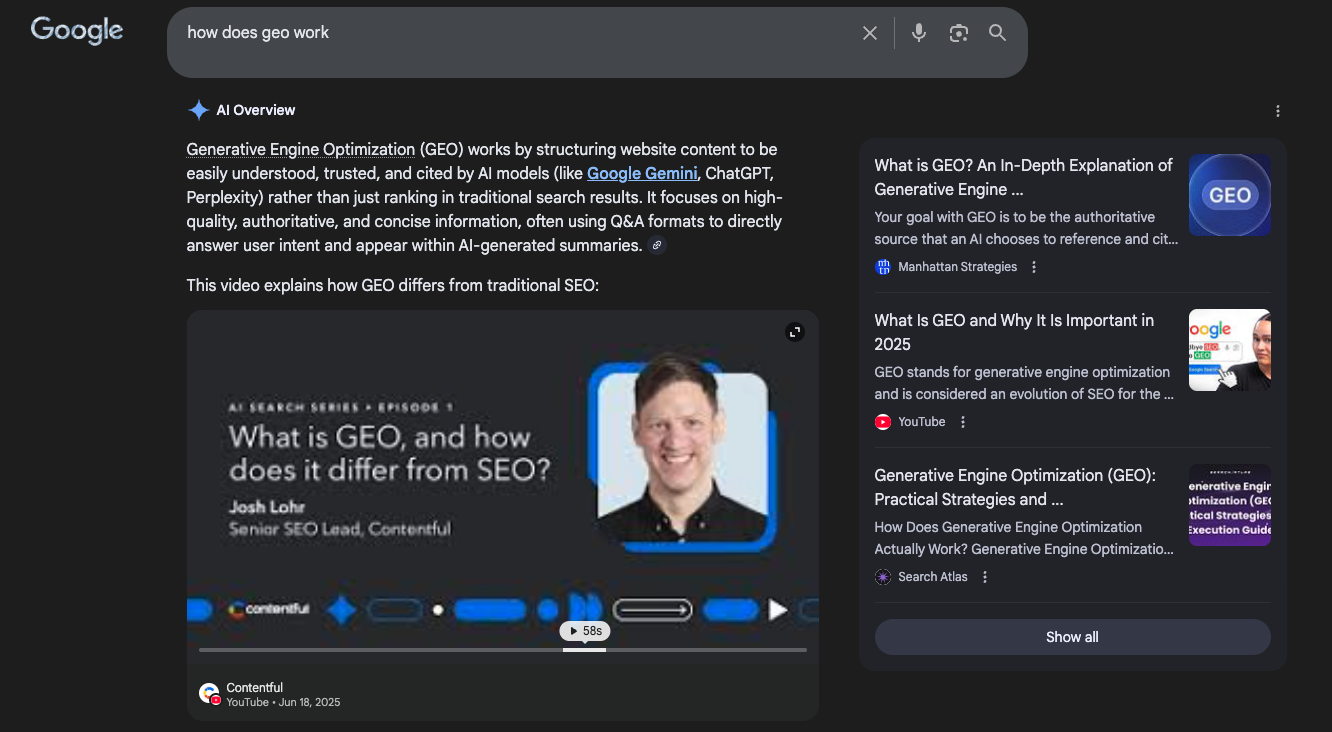

More users are getting what they need directly inside AI-generated experiences which means fewer traditional clicks and a bigger premium on being included andcorrectly represented in the answer itself.
Google has even published guidance specifically for how site content may appear in its AI features, underscoring that this shift isn’t theoretical anymore.
At Forgelight Marketing, we call this the start of a new, blended playbook: SEO still matters, but it’s no longer the whole game. The next era adds GEO (Generative Engine Optimization) optimizing your brand to show up as a trusted source inside AI-generated responses, summaries, and recommendations.
Major industry voices are framing GEO as “Act II” of search, where visibility is earned through how language models interpret and cite the web, not just how a page ranks on a results page.
What is GEO and how is it different from traditional SEO?
Traditional SEO focuses on rankings: keywords, technical health, backlinks, and in-page optimization to win a spot in the top results.
GEO focuses on inclusion and citation: ensuring your content is understood, trusted, and pulled into AI-generated responses (and that your brand is named accurately when that happens). In other words, your “ranking” becomesrepresentation. (HubSpot Blog)
A helpful mental model:
• SEO: “How do we rank higher in the organic search results?”
• GEO:“How do we become the source AI models use, and cite us, when it answers?”
Why GEO is showing up now
Three forces are colliding:
1. AI experiences are expanding in search. Google’s documentation now explicitly addresses how AI features work in Search and how to approach inclusion in those experiences.
2. Answer engines are becoming a discovery layer. Platforms like ChatGPT-style interfaces and AI-native search tools are changing how people research, compare, and decide.
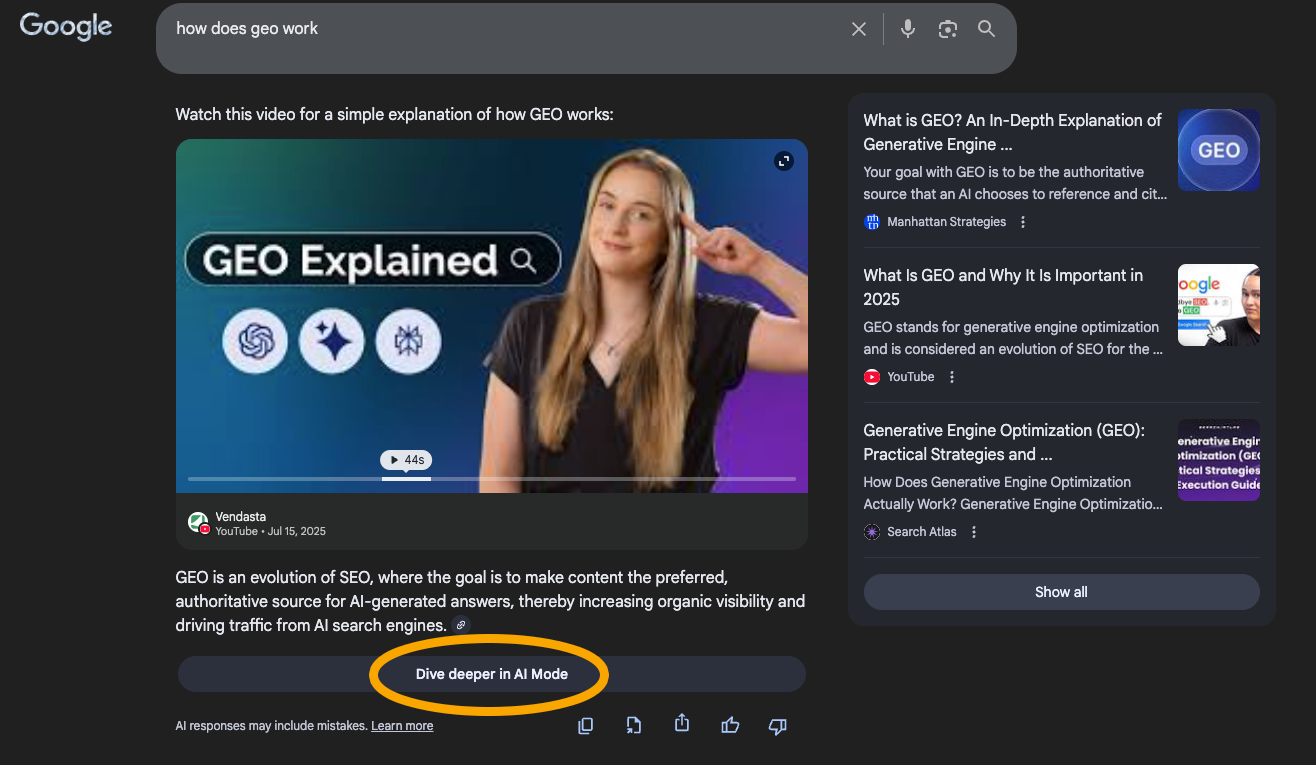
We’re seeing more people expand (aka. “Dive Deeper In AI Mode”) their research directly within the AI GEO results as opposed to clicking on additional links, sites, etc. No need to click and close 10 different websites when you can simply review AI generated responses.
Example:
3. The economics of visibility are shifting. If users get a summary and stop, your brand needs to be inside the summary not just a link somewhere down the page.
The new GEO playbook: what to do now
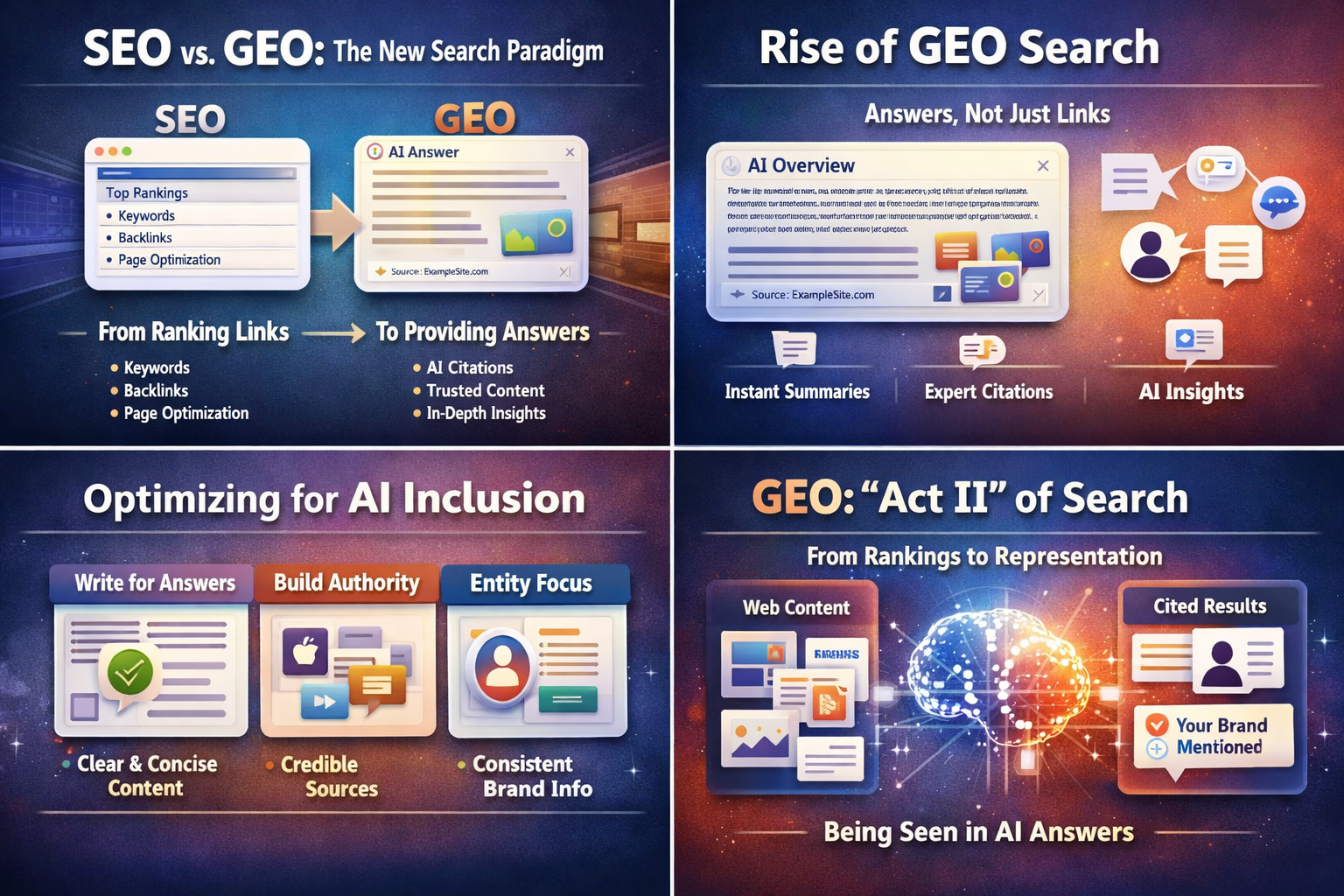
1) Write for “answer extraction,” not just “keyword coverage”
AI systems love content that’s easy to lift into a response:
· Use clear headings that match questions
· Provide direct, concise answers first, then expand
· Include definitions, steps, and decision criteria
· Add supporting details that demonstrate expertise (examples, edge cases, limits)
This aligns with mainstream GEO guidance that stresses structured, high-quality content designed for AI-powered experiences.
2) Become “citable”: increase your content’s authority signals
Language models (or LLM’s Large Language Models) and AI search experiences don’t just look at one page. That means your brand needs corroboration:
· Publish original insights (benchmarks, frameworks, real POV)
· Earn mentions from relevant third parties (PR, partnerships, podcasts, guest posts)
· Build a consistent footprint across reputable sites and profiles
A core GEO theme: presence across the web matters because AI responses are synthesized from many sources.
3) Optimize entities, not just keywords
In AI-driven discovery, your brand as an entity becomes critical. Strengthen the consistency of:
· Brand name variations
· Product names
· Leadership/experts
· Category descriptors
· “Known for” associations (what you want AI to connect you with)
This helps AI systems map your brand correctly and reduces the chance of inaccurate summaries.
4) Design content blocks that AI can safely reuse
Think: quotable modules.
Examples:
· “In 3 steps…” sections
· Pros/cons lists
· Comparison tables (when appropriate)
· Short “When to choose X vs Y” breakdowns
· FAQs that match real customer language
Google’s AI features guidance reinforces that you should approach content inclusion by focusing on helpful, accessible content that AI can surface to users.
5) Consider a New KPI Measurement: AI visibility
Classic metrics (rankings, sessions, CTR, etc.) are still useful but incomplete. GEO pushes you to monitor:
· Are we cited or referenced in AI answers?
· Are we described correctly?
· For which topics do we “show up” vs. disappear?
· Which competitors are being cited instead?
Common pitfalls we’re seeing
• AI content spam — pumping out generic posts that add no net-new value. AI systems are getting better at filtering low-signal content. Gone are the days of “hey ChatGPT . . . write me an article on GEO” and then cutting and pasting said article!
• Optimizing for prompts instead of customers — if it doesn’t match real decision journeys, it won’t sustain visibility.
• Ignoring representation risk — being mentioned inaccurately in AI summaries can be as damaging as not being mentioned at all, especially in regulated categories. Imagine a competitor writing your AI Summary for you AND misrepresents your pricing, reviews, and/or company as a whole!!!!!
The bottom line:
GEO is not going away in fact it’s a reflection of a deeper shift:discovery is moving from “finding links” to “getting answers.” SEO remains the foundation, but GEO is how you stay present when the interface itself becomes the recommender.
If you’d like, Forgelight can help you assess where your brand currently appears in AI-generated answers (and where it doesn’t), then map a GEO + SEO plan that fits your category, competition, and growth goals.